Stockity Tournaments 2026: Entry Fees, Prize Funds and What Is Not Published
Stockity runs paid trading competitions with large prize funds and small entry fees. What the tournaments page publishes, what the prize-to-fee ratio really says, and the rules Stockity does not publish at all.
Stockity runs paid trading competitions alongside its ordinary platform, and they are easy to misread. The Stockity tournaments page shows large prize funds next to small entry fees, with countdown timers ticking. What the Stockity tournaments page does not show is the rulebook. This review covers what is published about Stockity tournaments as of 14 October 2026, what the numbers actually tell you, and the parts a reader has to go and ask for.
Everything below was read from Stockity's own public pages. We did not register, deposit, or enter any tournament. You can open the platform yourself at the official Stockity site.
PrimeFXHub review summary: Stockity tournaments at a glance
Stockity is an online platform for short-term trades on the price of global assets, with 140+ instruments and a published user base of 3.5 million across 130+ countries — company figures, not independently audited. Stockity tournaments sit on top of that: time-boxed competitions with a paid entry and a pooled prize fund.
What they are: paid competitions, not free promotions. The entry fee is real money.
What is published: tournament name, status, countdown, participation fee, prize fund.
What is not published: the rules. No scoring method, no participant count, no payout table.
Who can enter the VIP ones: only the VIP and Platinum account tiers.
Our rating: 4.5 / 5 for the platform overall, with the transparency gaps below weighed against it.
What Stockity tournaments actually are
Stockity tournaments are competitions that run for a fixed window. You pay a participation fee to enter, you trade during the window, and a prize fund is distributed at the end. That is the shape of Stockity tournaments — and the first thing worth saying plainly is that the participation fee is charged in real money, not virtual funds.
This matters because Stockity also offers a demo account with $10,000 in virtual currency, and the two are easy to conflate. Practice mode costs nothing and pays nothing. Stockity tournaments cost money to enter and can pay money out. Stockity tournaments are a live-money activity sitting inside a platform whose core product is already a fixed-time prediction instrument.
On that core product: Stockity's own FAQ describes opening a trade as four steps — choose an asset, enter the amount, set the time the trade closes, then click green or red depending on where you think the price will go. The "profitability up to 83–85%" figure quoted across the site is the payout on a correct call, not a rate of return. An incorrect call costs the amount staked. Trading inside Stockity tournaments runs on that same mechanic.
The three Stockity tournaments running right now
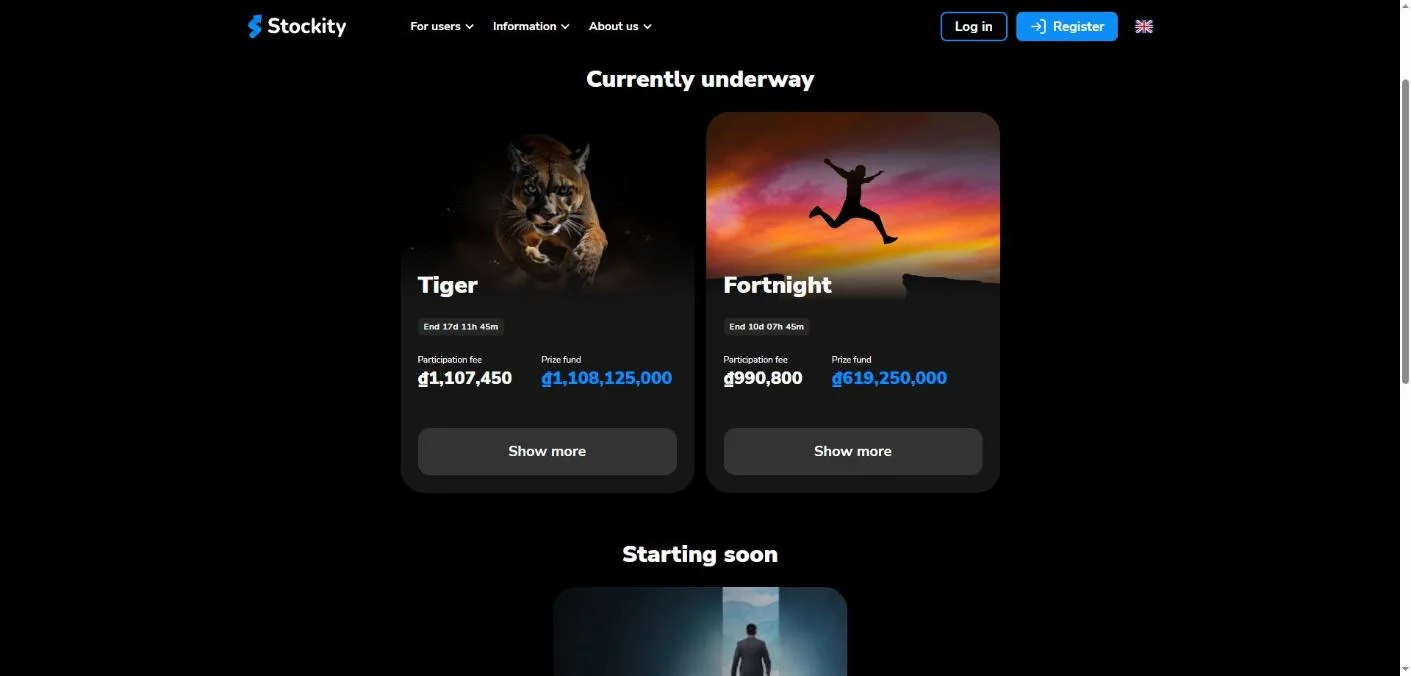
Read on 14 October 2026, the page listed two competitions underway and one about to start:
Tiger — underway, 17 days 11 hours left. Participation fee ₫1,107,450. Prize fund ₫1,108,125,000.
Fortnight — underway, 10 days 07 hours left. Participation fee ₫990,800. Prize fund ₫619,250,000.
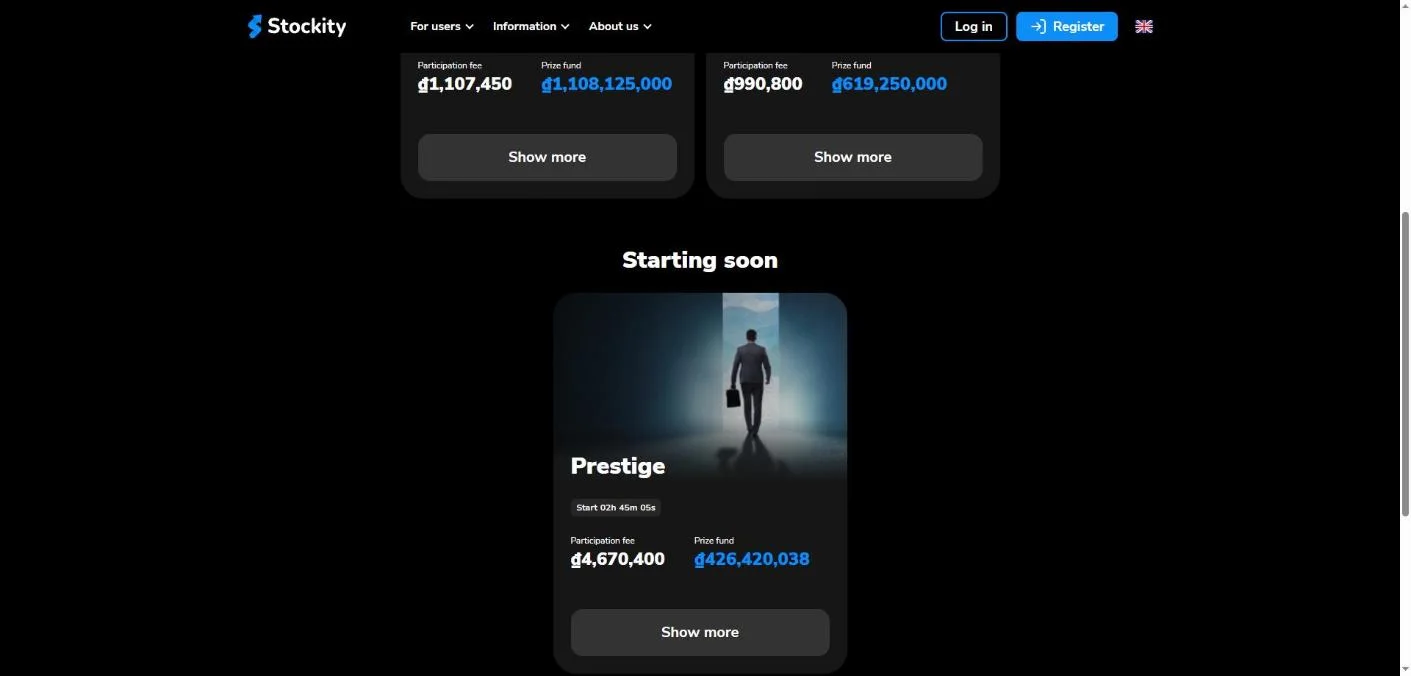
Prestige — starting in 2 hours 45 minutes. Participation fee ₫4,670,400. Prize fund ₫426,420,038.
⚠️ A necessary caveat on those figures. Stockity displays amounts in the currency of the visitor's region. We read the page from a region where it renders in Vietnamese dong, so the numbers above are the dong view. Check the fee in your own currency on the live page before reading anything into the size of it — we have deliberately not converted, because an invented exchange rate would make the figures look more precise than they are.
Stockity tournaments: prize fund versus entry fee
There is one way to compare Stockity tournaments that does not depend on currency at all: divide the prize fund by the participation fee. That ratio is the same number whatever currency the page renders in, and it tells you how many entry fees' worth of prize money is on the table.
Tiger: prize fund ≈ 1,001× the entry fee
Fortnight: prize fund ≈ 625× the entry fee
Prestige: prize fund ≈ 91× the entry fee — despite having the highest entry fee of the three
That last line is the interesting one. Prestige costs roughly four times more to enter than Tiger, and its prize fund is about one eleventh the multiple. On the published numbers alone, the three Stockity tournaments are not variations of one format — they are differently shaped propositions, and a reader comparing them on prize fund alone would draw the wrong conclusion.
What the ratio cannot tell you is your chance of winning anything in Stockity tournaments, because that depends on how many people enter and how the fund is split. Neither number is published.
What Stockity does not publish about its tournaments
This is the honest centre of this review. Clicking Show more on any of the three Stockity tournaments does not open a rulebook — it reveals a countdown timer. As of 14 October 2026, the public Stockity tournaments page does not state:
How a winner is determined. Highest balance? Highest percentage return? Most trades closed in profit? Not published.
How the prize fund is distributed. One winner, top ten, a sliding scale? Not published.
How many people have entered, so there is no way to estimate the odds of placing.
Whether the entry fee is refundable if a tournament is cancelled or you withdraw.
Whether the prize fund is guaranteed or scales with the number of entrants.
Stockity's Client Agreement, which might contain some of this, returns a blank page to a logged-out visitor — it sits behind registration. So does the Copy Trading Agreement. Our position is simple: we are not going to guess at rules that are not published, and a reader should not pay an entry fee for a competition whose scoring method they have not read.
Who gets into the VIP Stockity tournaments
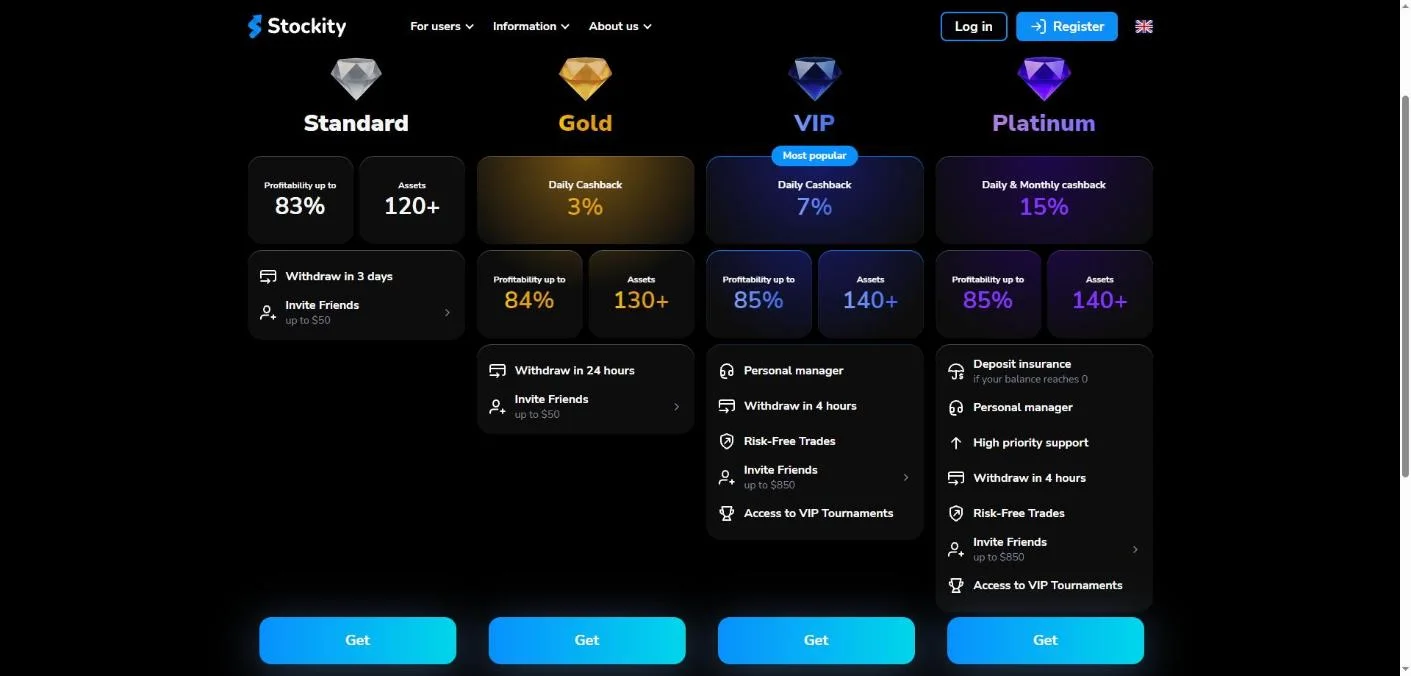
Not every Stockity account can enter every one of the Stockity tournaments. The published account tiers make that explicit: Access to VIP Tournaments appears only on the VIP and Platinum tiers. Standard and Gold accounts do not list it.
Standard — payout up to 83%, 120+ assets, withdrawals in 3 days
Gold — 3% daily cashback, payout up to 84%, 130+ assets, withdrawals in 24 hours
VIP — 7% daily cashback, payout up to 85%, 140+ assets, withdrawals in 4 hours, personal manager, risk-free trades, VIP tournaments
Platinum — 15% daily and monthly cashback, payout up to 85%, 140+ assets, deposit insurance if the balance reaches zero, high-priority support, VIP tournaments
Stockity does not publish the deposit thresholds that unlock these tiers, which means the real cost of reaching VIP tournament access is also unpublished. Current tier benefits are listed on the Stockity platform.
Regulation and client protection behind Stockity tournaments
Reported exactly as published, because the two sources do not line up neatly.
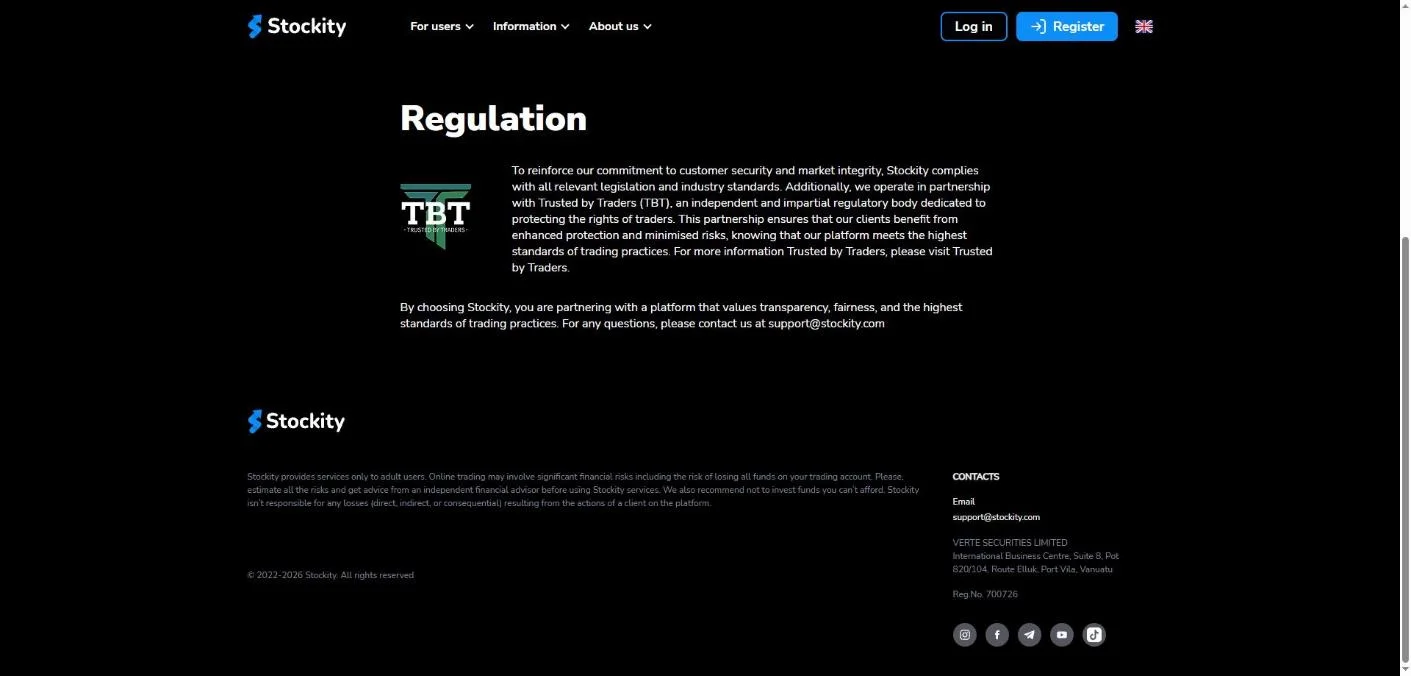
Stockity's Regulation page states the platform is "fully licensed and regulated with a Principal's License №700726". That page names no issuing authority and no country of licensing.
The site footer names a company: VERTE SECURITIES LIMITED, International Business Centre, Suite 8, Pot 820/104, Route Elluk, Port Vila, Vanuatu, with Reg.No. 700726.
Those are the same number — presented once as a licence and once as a company registration number. Both statements are Stockity's own. We report them side by side rather than deciding which framing is the right one.
Stockity says it works "in partnership with Trusted by Traders (TBT) — an independent, impartial regulatory body". TBT's own website describes monitoring platform compliance and handling disputes, but states no government authority, no legal mandate and no licence of its own, and does not say who owns or runs it.
Stockity also states it follows regulatory standards for client fund handling, undergoes audits and compliance checks, and applies AML and KYC obligations.
Anyone can check independently whether a platform has been flagged by a national regulator. The securities regulators' own alert database is public and free: the IOSCO International Securities & Commodities Alerts Network is searchable by country, regulator and firm name. Running that search costs nothing and is worth doing before any entry fee or deposit, on any platform.
Costs to check before entering Stockity tournaments
Beyond the Stockity tournaments entry fee itself, the costs that matter here are the ones Stockity does not put a number on.
Minimum deposit: not published. The FAQ says only that a minimum deposit is required to trade live.
Tier thresholds: not published, so the cost of reaching VIP tournament access is unknown.
Restricted countries: not published. The Client Agreement is behind registration.
The spread between payout and stake: a correct call returns up to 83–85% on top of the stake; an incorrect one returns nothing. Over many trades that asymmetry is the real cost structure, tournament or not.
Platforms and execution
Stockity tournaments run on the same software as everything else: the web platform plus apps on Google Play and the App Store, with a direct Android APK download also offered. Trades are placed from the same interface in practice and live mode, and the balance selector at the top of the trading screen switches between them at any time.
One documentation oddity worth flagging: the FAQ entry headed "Do you have a mobile app?" does not answer the question — it invites you to subscribe to emails. The download links on the homepage are the reliable source.
Deposits, withdrawals, and support
Deposits are mostly instant; bank transfers take longer.
Stockity says it processes most withdrawal requests within 24 hours, with headline speeds by tier: 3 days on Standard, 24 hours on Gold, 4 hours on VIP and Platinum.
You can trade before verifying, but you cannot withdraw before verifying. Identity verification is mandatory to withdraw.
You cannot verify in advance. Stockity confirms the system only prompts for verification once you reach a certain trading volume or request a withdrawal.
Verification needs a clear ID photo and valid proof of address; approval is confirmed by email.
Two-factor authentication via an authenticator app is available in Security settings.
Support is by email at the address published on the site.
Plan for the verification step before you enter one of the Stockity tournaments, not after you have won something. You can review the current deposit and withdrawal options on the Stockity site.
Who may want to research Stockity tournaments
Stockity tournaments may suit a trader who already uses the platform, already understands that the core product is a fixed-time prediction instrument, and treats a tournament entry fee the way they would treat any other discretionary stake — money they are prepared to lose entirely.
Stockity tournaments are a poor fit for someone new to the platform. The sensible order is the free demo account first, then a funded account if the platform suits, and only then the paid Stockity tournaments, whose rules you have read inside your account. Paying to enter a contest before you have seen its scoring method is not a strategy.
How this Stockity tournaments review was done
We did not register with Stockity, deposit funds, enter a tournament or place a trade. This is a desk review built from Stockity's published pages, read on 14 October 2026: the homepage, the tournaments page, the account statuses page, the Regulation page, the About page and the public FAQ, plus the Trusted by Traders website. Figures Stockity publishes about itself — user numbers, asset counts, payout percentages, the 4.8 rating on its homepage — are labelled as company claims throughout. Where a document was not reachable by a logged-out visitor, we have said so rather than guessing at its contents. Stockity's homepage testimonials carry first names and countries; we have not reproduced them.
Risk warning
Stockity's own warning, quoted in full: "Stockity provides services only to adult users. Online trading may involve significant financial risks including the risk of losing all funds on your trading account. Please, estimate all the risks and get advice from an independent financial advisor before using Stockity services. We also recommend not to invest funds you can't afford." The footer adds that Stockity "isn't responsible for any losses (direct, indirect, or consequential) resulting from the actions of a client on the platform."
Entry fees for Stockity tournaments are an additional cost on top of trading losses, and paying one does not improve the odds on any individual trade. Nothing in this article is financial advice and we are not financial advisers — a point Stockity makes about its own services too. If you decide to look further, start on the official Stockity platform and read the Client Agreement once you can see it.