Fomo App Review 2026: The Self-Custody Trading App With 500K Downloads
Fomo is a social-first crypto app that keeps you in self-custody, sponsors gas and funds by Apple Pay. We look at the fees, the chains, the scale claims and the withdrawal complaints.
Disclosure: this article contains affiliate links. If you sign up through them we may earn a commission at no extra cost to you. Every figure below is sourced and attributed.
PrimeFXHub review summary
Fomo is a social-first crypto trading app built by fomo Labs Inc., a US startup founded by two former Uniswap and OpenSea engineers, Paul Erlanger and Se Yong Park. It launched in May 2025 and has raised roughly $19 million, including a $17 million Series A led by Benchmark, with Solana co-founder Raj Gokal among its backers.
The reason it deserves a serious look is not the social feed. It is the architecture underneath: Fomo is self-custodial. Private keys are split using Shamir’s Secret Sharing across separate systems, which means — by the company’s own description — Fomo cannot move your assets. You get an app that onboards like a consumer fintech product, funded by Apple Pay, but the balance sits in a wallet only you control. You can see the current setup on the Fomo website.
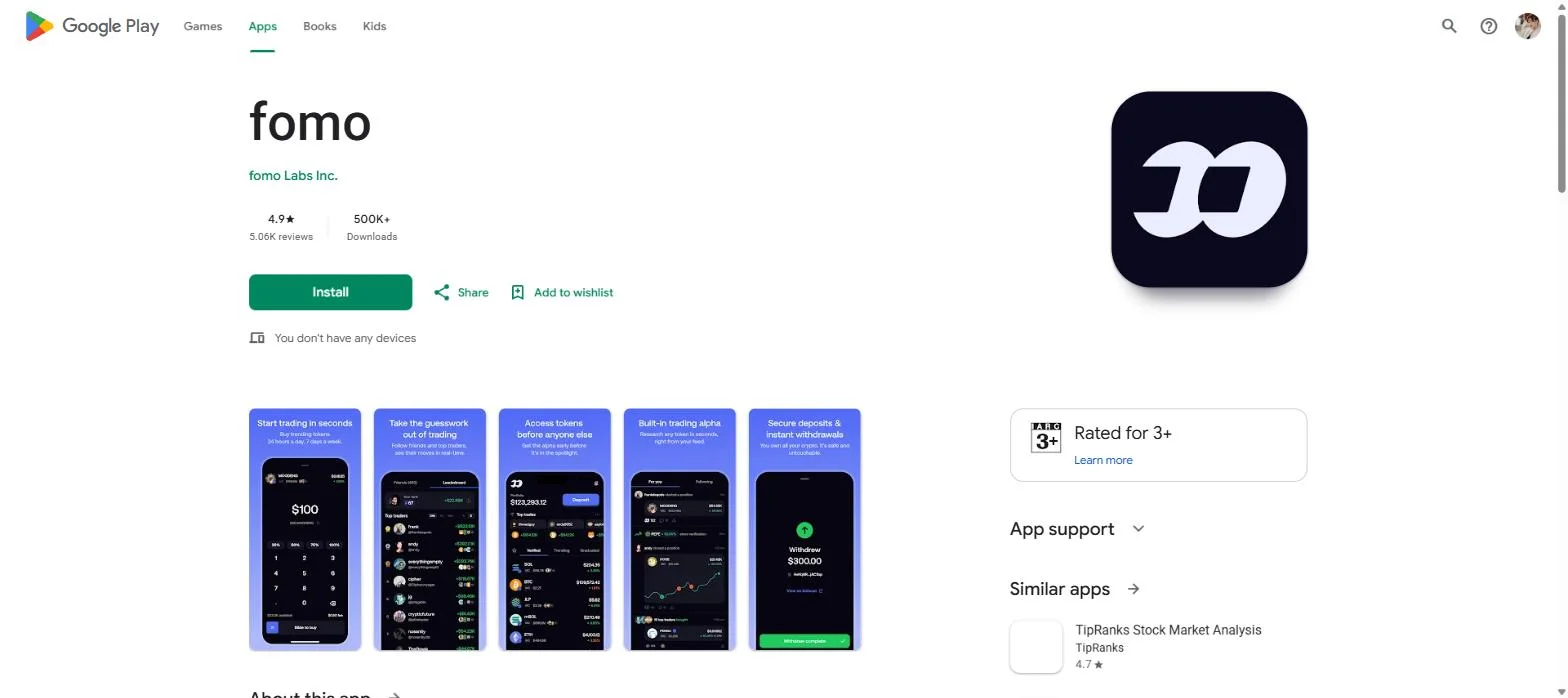
On the consumer side the reception has been strong. On Google Play the app holds 4.9 stars from 5,060 reviews with 500,000+ downloads, and it was last updated on 6 September 2026 — a shipping cadence that matches the funding.
What it is not is a regulated broker, and that distinction runs through everything below.
Regulation and client protection
Fomo is not a regulated broker or exchange. There is no FDIC or SIPC coverage, no deposit protection scheme, and no regulator to appeal to. This is the standard position for a self-custodial wallet app rather than an anomaly — but it is a genuinely different risk profile from a licensed brokerage, and it should be the first thing you weigh.
Self-custody cuts both ways, and the downside deserves plain wording. Because Fomo does not hold your keys, Fomo also cannot restore your account. Lose device access without a backup and the funds are not recoverable by support, by the company, or by anyone else. The same property that makes the app trustworthy in the “not your keys, not your coins” sense makes it unforgiving of user error.
Perpetual futures are not available to US persons.
Costs to check
Fomo’s pricing is unusually easy to read for an on-chain app, because the quote bundles the app fee and the routing cost together before you confirm:
Spot trading: around 0.5% per trade, with a stated minimum of about $0.95 on certain chains
Perpetuals: a 0.05% builder fee per side, charged on both open and close
Gas is sponsored by the platform on supported flows, so small trades are not eaten by network fees
$0 fee on your first buy, shown directly in the Apple Pay funding panel
A referral code takes 10% off trading fees
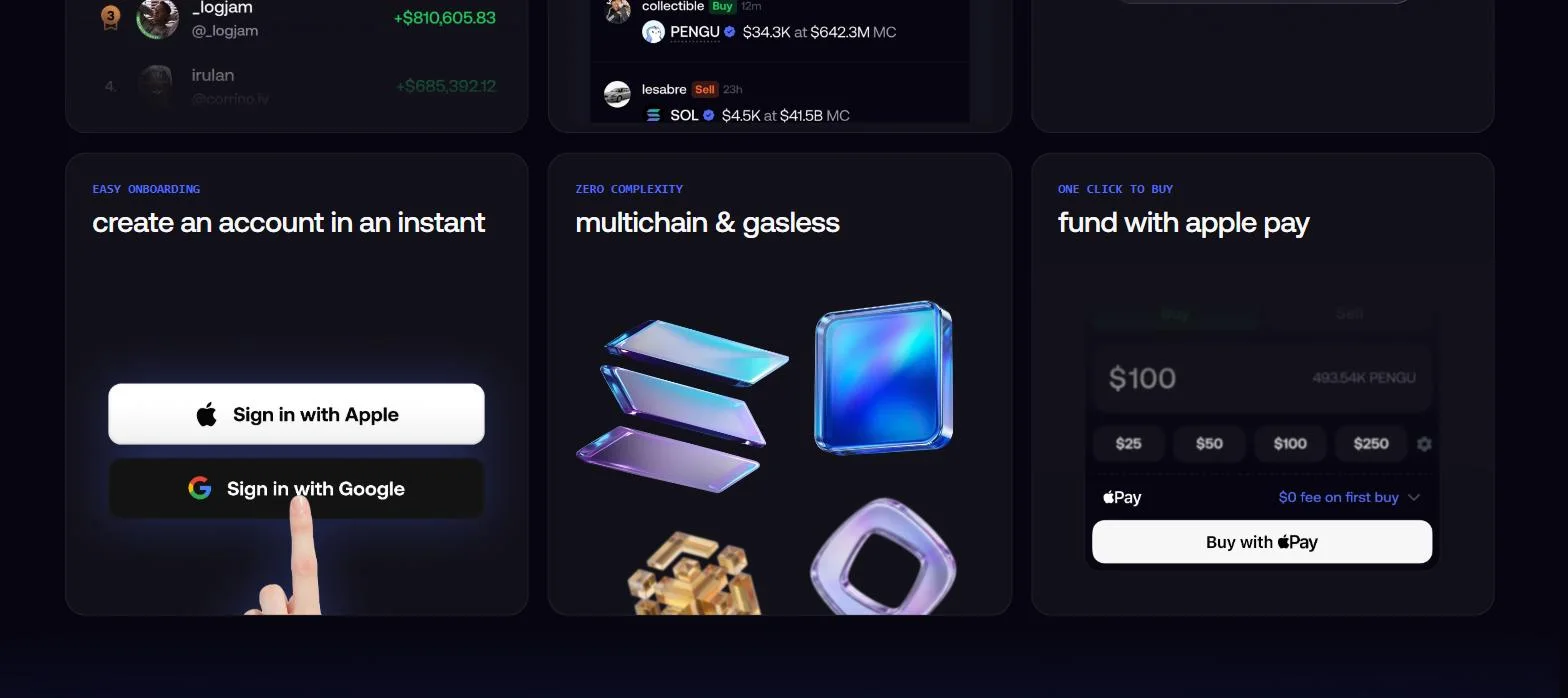
The gasless design is the part that actually matters for small accounts. On most on-chain apps a $30 memecoin trade can lose a meaningful slice to network fees before the position even opens; Fomo absorbing gas removes that.
The honest counterweight is the $0.95 minimum. At 0.5%, that minimum only stops binding above roughly $190 per trade — below that you are effectively paying a flat fee that gets proportionally worse the smaller you trade. A $20 trade pays close to 4.75%. If your pattern is lots of tiny trades, model this before you commit.
Platforms and execution
Fomo runs on iOS, Android and web, and positions itself around continuity — open a trade on your phone, close it on your desktop, in one app.
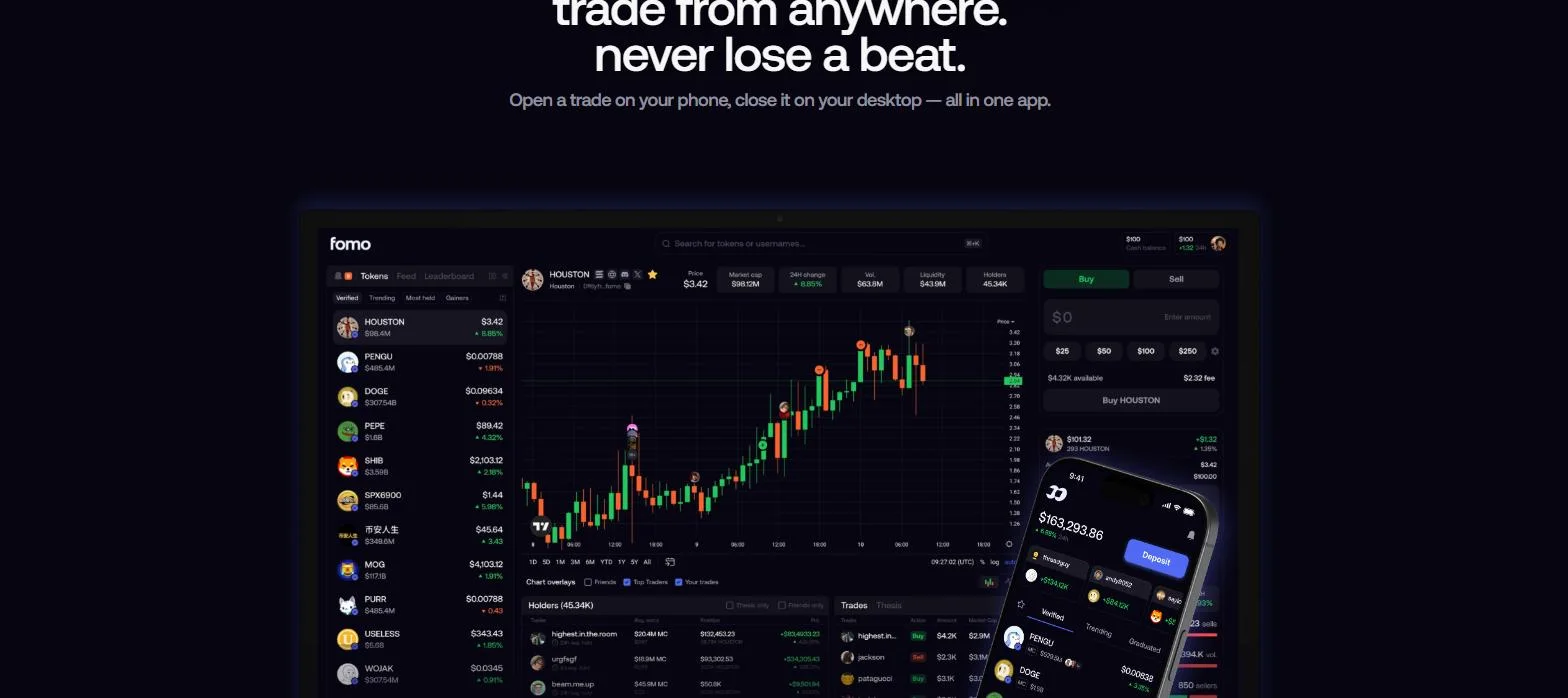
Multichain coverage is broad for an app this young: Solana, Base, BNB Chain, Ethereum, Monad and Robinhood Chain. Assets span memecoins, established altcoins and stablecoins, with “verified token” labelling for assets that pass basic safety checks, plus automated contract risk checks on what you are about to buy.
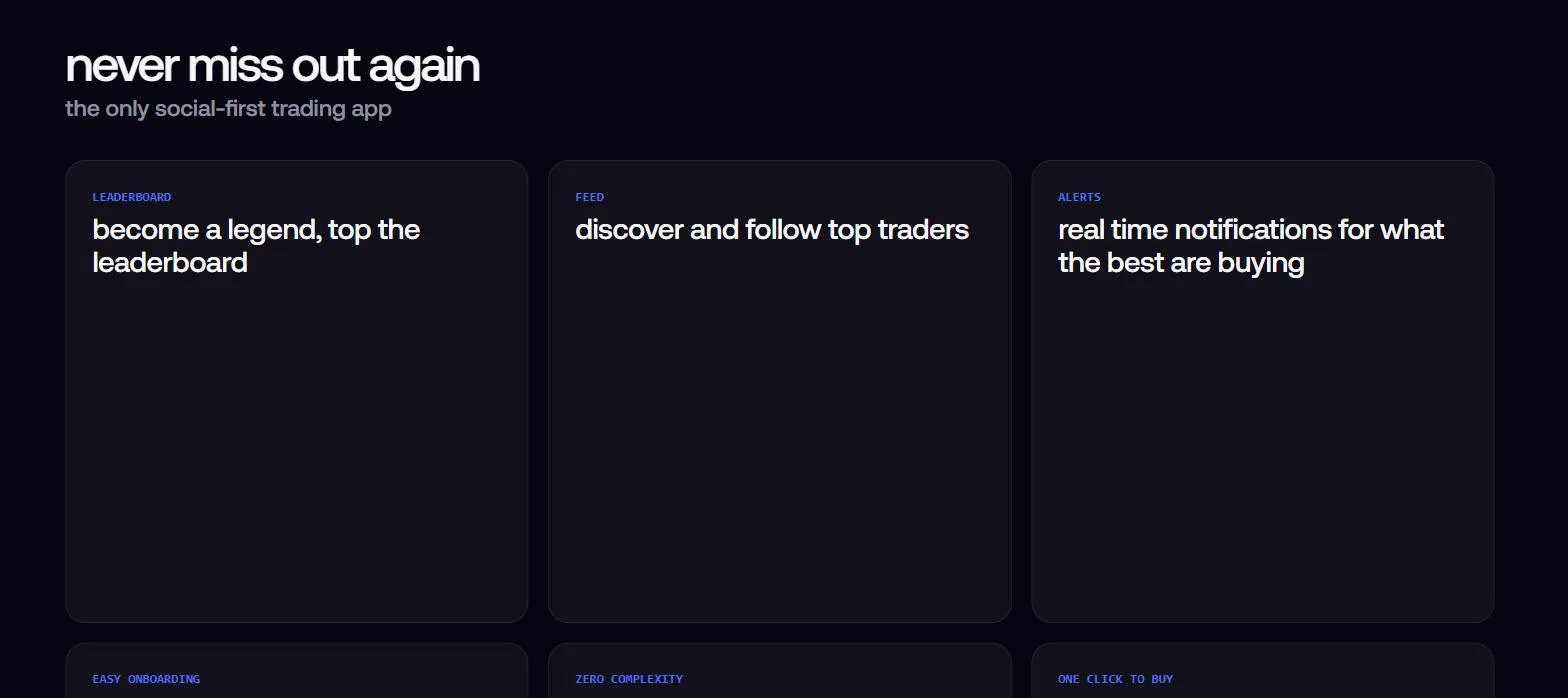
The social layer is the headline feature: follow other traders, see what they are buying in real time, copy trades, climb a leaderboard, and get alerts when the accounts you follow move. Built-in PnL tracking and profit history sit alongside it.
One independent review reports that Fomo has processed $1.52 billion in lifetime trading volume across 3.47 million transactions, generating $5.16 million in platform fees — real throughput rather than a launch-stage product.
A note on scale, because the numbers deserve care. Fomo’s own site says “join 500,000 traders”. That figure matches the 500,000+ downloads on Google Play rather than active accounts, and the same third-party review counts roughly 55,000 lifetime users and about 15,000 monthly active. Both can be true; they measure different things. Read the 500,000 as reach, not as an active user base.
Deposits, withdrawals, and support
Funding is the strongest part of the product for a newcomer:
Apple Pay and Google Pay
Debit card via a Coinbase-powered on-ramp
Direct crypto deposits from an external wallet
That removes the exchange-account step that usually sits between a curious buyer and their first on-chain trade. You can check the current funding options on the Fomo signup page.
Support and withdrawals are where the complaints cluster, and they should be weighed. App Store and Trustpilot reviewers have reported verification blocks preventing withdrawals, and a recurring theme that money goes in easily but can stall coming out. There are also reports of sell orders failing while buys went through, and of generic copy-and-paste replies from the developer.
Two things to hold alongside that. The Trustpilot sample is only two reviews, both one-star — far too small to draw a conclusion from in either direction. And it sits against 5,060 Google Play reviews averaging 4.9. The fair reading is that withdrawal friction is a real reported issue on a young platform, not that it is the typical experience.
Who may want to research Fomo
Potentially a good fit: people who want on-chain exposure without running a wallet, a seed phrase and a DEX interface themselves; small-size traders who benefit from sponsored gas; anyone who values self-custody but has been put off by the setup burden; traders who actively want social discovery and are clear-eyed about what it does to their decision-making.
Probably not a fit: anyone who needs regulatory protection or insured deposits; traders who place many very small orders, where the $0.95 minimum dominates; US persons wanting perpetuals; anyone who cannot reliably manage a backup, because there is no recovery path; and anyone who knows they trade emotionally.
If you do decide to test it, the sensible approach is a small first position funded by card, checking that a withdrawal completes before scaling up. Current fees and supported chains are listed on the Fomo app page.
That last point deserves its own sentence. Feeds, alerts and leaderboards are engagement mechanics, and at least one reviewer argues the social layer encourages exactly the behaviour the app is named after. The product is well built; the incentive it creates is to trade more. Those are separate questions.
Do your own research, size positions accordingly, and never fund an unregulated app with money you cannot afford to lose. This article is research, not financial advice.